


Speaker

Abstract
I spent the last two years as an architect of the next mobile gaming platform at meta, with the ambition that anyone can create, share, and play AI-generated mobile games. What I learned is that the hard part is no longer the generation — it's everything that happens after.
Runtime LLMs power NPCs that never say the same thing twice. That's magical for players and a nightmare for QA. AI generates millions assets a day but most of them are rejected for production readiness. Model updates break half of the game already built. One engineer's AI coding experiments cost us tens of thousands of dollars a month.
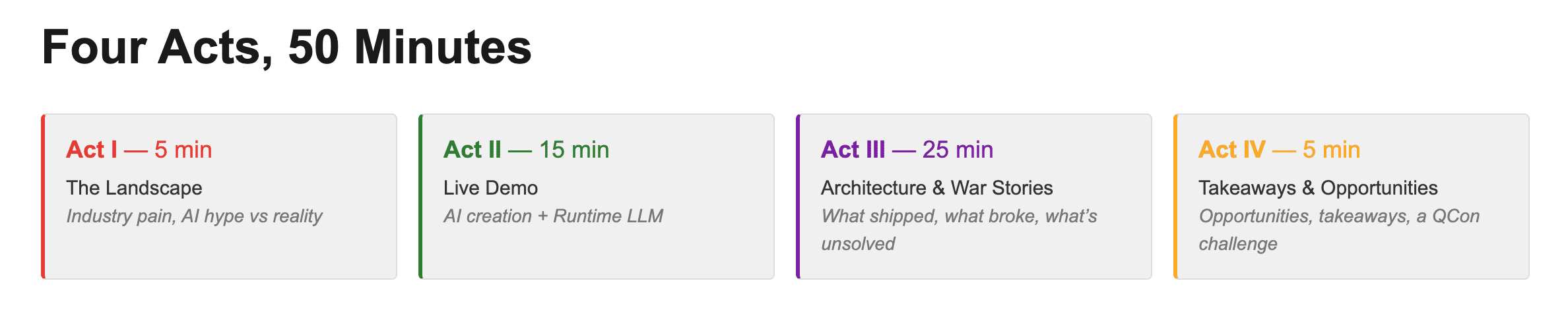
This session walks through the full architecture and open challenges of building an AI driven platform. I'll show live demos, share design insights, learnings from being on the frontlines, and be honest about the problems we haven't solved yet that need you.
Interview
This sessions goes through how AI breakthroughs have changed game development and what areas of opportunities exist for mobile developers.
As in the industry shifts rapidly, it's important for us to know what areas are changing, and what opportunities they bring.
Gaming platforms require full stack systems as well as specialized skillsets to build. Balancing performance, cross-platform deployment with increasing shorter production timelines remains a challenge.
Their own game with AI.
The caliber of speakers and the conference itself, plus the people it brings together from all over the world.
Topics
QCon London 2026 is a three day conference for senior software engineers, architects and team leads. An international program committee of working engineers selects every session. Patterns and practices, not products and pitches.
Part of the track
Emerging Trends in the Frontend and Mobile Hosted by Ian Thomas Software Engineer @Meta, QCon London & San Francisco Co-Chair, International SpeakerFrom the same track
Wednesday 18 March
10:35 Mountbatten (6th Fl.) Session AI Tools That Enable the Next 1B Developers Ivan Zarea Director of Platform Engineering @Netlify The developer population is growing by orders of magnitude. The new AI tooling is turning domain experts and operators into builders. Unfortunately, the tools and the platforms they are building on weren't designed for them. 11:45 Mountbatten (6th Fl.) Session GUI Agents Computer Use Agents: The Frontier of Vision-Based Automation Stefan Dirnstorfer CTO @Thetaris GmbH, Architect of ThetaML & Thetaris’ Testing Application, 42 Years into Software Computer Use Agents represent a paradigm shift in software interaction: AI models trained to operate interfaces visually, mimicking human interaction rather than relying on technical APIs. 13:35 Windsor (5th Fl.) Session Panel: Who Builds the Frontend Now? (And What Breaks When They Do) Luca Mezzalira, James Hall, Danielle An, Ivan Zarea This panel is for frontend and mobile engineers trying to make sense of what's actually happening versus what's hype. Practitioners from platform infrastructure, observability, serverless architecture, digital consultancy, and mobile development will share what they're seeing on the ground and debate what it means. 14:45 Windsor (5th Fl.) Session GenAI Architecting AI Driven Game Creation: From Research to Production Scale Systems Danielle An Principal Engineer / GenAI Architect @Meta, Ph.D. with 15 years of professional experience in film, MR and gaming I spent the last two years as an architect of the next mobile gaming platform at meta, with the ambition that anyone can create, share, and play AI-generated mobile games. What I learned is that the hard part is no longer the generation — it's everything that happens after. 15:55 Mountbatten (6th Fl.) Session Running AI at the Edge: Running Real Workloads Directly in the Browser James Hall Founder and Director @Parallax, Author of jsPDF Running AI today often means choosing between Anthropic or OpenAI, and accepting the cost and privacy concerns that come with shipping data to third-parties. What if there was another way?